
Understanding the Role of the Substrate
Every successful roof restoration begins with understanding the actual condition of the surface beneath the coating. Metal roofs accumulate corrosion, oxidation, loose fasteners and weakened seams. Concrete roof decks develop cracks and embedded contaminants. None of these issues can simply be “covered up.” They directly affect adhesion, curing behavior and long-term waterproofing performance. Surface preparation is the technical foundation that determines whether the coating system will function as designed or fail prematurely.
The Science Behind Proper Cleaning
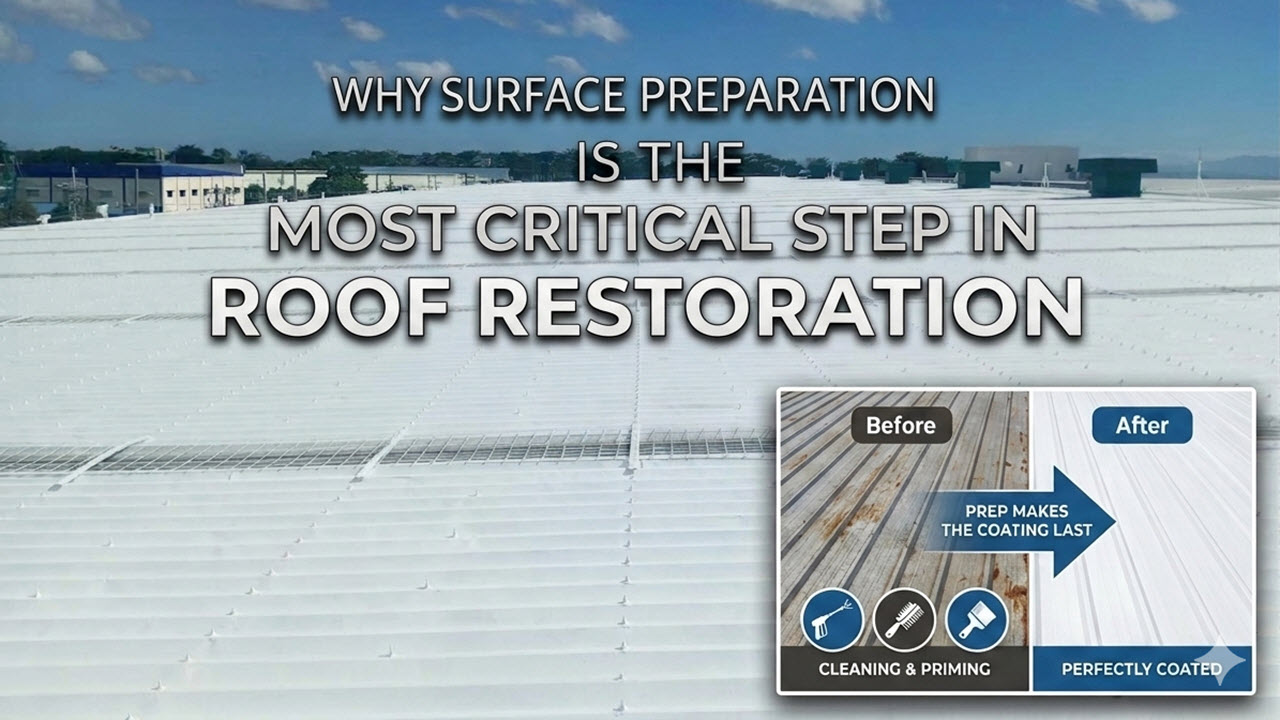
Cleaning is a technical requirement. Dirt, fungi, chalking, oils, pollution deposits and remnants of old coatings all act as physical and chemical barriers between the substrate and the new membrane. High-pressure cleaning removes loose contaminants, while chemical or mechanical treatments address deeper oxidation or residue. Once the surface is clean, the real substrate condition becomes visible, revealing rust activity, cracks, moisture, or structural weaknesses that must be corrected before coating.
Treating Corrosion on Metal Roofs
Corrosion is one of the biggest threats to metal roofing systems. Rust does not stop on its own and will continue spreading underneath coatings if left untreated. Effective rust treatment converts active corrosion into a stable, bondable surface. This prevents ongoing deterioration and ensures the primer can properly anchor to the substrate. When rust remediation is rushed or skipped, the coating may initially look fine but will eventually blister, peel or delaminate because the metal beneath continues to break down.
Diagnosing and Repairing Concrete Cracks
Concrete roof decks require a different approach. Cracks may seem small but can function as direct water pathways. Before coating, cracks must be opened, cleaned, filled and sealed so that movement and moisture do not compromise the membrane. Moisture testing is equally essential. Excess moisture prevents the coating from bonding and curing correctly, which can lead to bubbling and early membrane failure. Understanding the physical condition of the concrete is essential for a long-lasting restoration.
Why Primer Compatibility Matters
Primers act as the chemical bridge between the substrate and the final coating system. Not all primers work on all surfaces. Their effectiveness depends on the roof’s porosity, material type, moisture condition and environmental exposure. A surface that is dirty, loose, unstable or improperly dried will prevent the primer from forming the bond needed for long-term adhesion. Many coating failures trace back to incorrect primer selection or poor surface readiness rather than the coating product itself.
How Poor Preparation Leads to Coating Failure
When preparation is inadequate, the most common issues include peeling, delamination, blistering, cracking and water intrusion. These failures rarely originate from defective materials. They arise because contaminants, moisture or structural weaknesses were left unaddressed beneath the coating. The failure may not occur immediately but will appear over time as the roof expands, contracts or absorbs heat and moisture. Once adhesion is compromised, the performance of the entire system deteriorates quickly.
Why Preparation Determines Long-Term Performance
A well-prepared roof allows the coating to bond, stretch, cure and perform the way its chemistry intends. This is what supports warranty validity and prevents recurring leaks or costly callbacks. When surface preparation is executed properly, the restored roof maintains its protection for many years and can even be renewed at the end of its life cycle with another coating application. This renewability is a major advantage over traditional replacement.
The Reason ROSH Treats Preparation as a Core Technical Discipline
For ROSH, surface preparation is not optional and not a rushed preliminary step. It is the single most important phase of the restoration process. Our methods ensure that the substrate is clean, stable, dry, reinforced and ready to accept a high-performance coating. When the foundation is strong, the system behaves exactly as engineered, creating a seamless, durable membrane that protects the building against harsh weather and operational demands.